You’ve started a blog, but you’re not getting any results. You’re not alone.
Because you’re making some common blogging mistakes.
You’re working hard to get noticed. But still, you’re not getting the desired results.
I know it’s frustrating. I’ve been there. I can relate to your pain.
You might feel like giving up.
Don’t worry!
Take a deep breath.
You can get results. Yes, you can get traffic, leads, and sales through your blog.
Whenever we start something new, we are bound to make mistakes.
What if you know the mistakes and the solutions as well?
You can achieve results sooner if you know how to avoid blogging mistakes.
How do I know all these?
I started my first blog at the age of 16. Like most bloggers, I got no results for 5 months. But I never gave up. The only way I could lose is to give up. But I didn’t.
In the 6th month, I started getting organic traffic from Google. And everything changes from there.
In this post, I’ll share some common mistakes bloggers make and how you can avoid them.
Let’s dive right in.
#1 Not Writing For Your Audience
This is a common mistake many bloggers make. I made the same mistake in the early days of my blogging. I used to read other bloggers and try to like them.
You should avoid that.
You need to know who your target audience is before you start writing. And what are their pain points?
Unless you know it, you’ll struggle to see some fruitful results.
The content you publish must resonate with your audience. Your goal should be to solve the problems of your readers. This is how you can build trust with your blog readers.
For example, if you sell coffee makers. You should write to solve their problems.
Here are some post ideas:
- The Ultimate Guide to Cleaning Your Coffee Maker.
- My Coffee Maker Isn’t Brewing: Common Issues and Quick Fixes.
- Why Is My Coffee Maker Leaking? And How To Fix It.
When you solve problems of your audience, they’re going to trust you.
#2 Targeting Wrong Keywords
Targeting the wrong keywords is one of the biggest blogging mistakes that can waste time and money.
You need to understand the intent behind the keyword.
Here’s how you can do it.
Google your topic/keyword and analyze the top 10 posts. Analyze what types of pages rank higher. Are they informational articles, product pages, or listicles?
This will help you understand the search intent.
Let me show you:
I Googled “best coffee makers for home under $500.” You can see that most pages are listicles.

If you want to rank for this keyword, you need to write a listicle post.
Another tip I’ve for you is to go after long-tail keywords. Don’t chase high volumes and competitive keywords.
If you want a blog about headphones, you should go after keywords like: “noise-canceling over-ear headphones for commuting”.
You need to conduct thorough keyword research. If you’re new to the game, it can take longer. It will be worth the time.
For keyword research, you can use Semrush, Ahrefs, or Ubersuggest. All these tools have free versions.
Pro Tips: Use multiple tools. Because no tool is perfect.
#3 Not Selling
Selling has a bad reputation. But it’s not like you’re calling someone at midnight to sell insurance.
You’re selling on your blog. If someone is reading your blog, you might be interested in your product/service.
People have a misconception that they need a lot of views to sell. It’s far from the truth. You need a strategy that aligns with your marketing goals.
With the GEN AI boom, it’s even more important. Here’s why.
Now people are using GEN AI platforms like ChatGPT, Gemini, Perplexity, and Claude to find solutions. These AI platforms don’t rank like Google’s traditional search; they recommend and cite.
Many times, these AI platforms pull content from blogs.
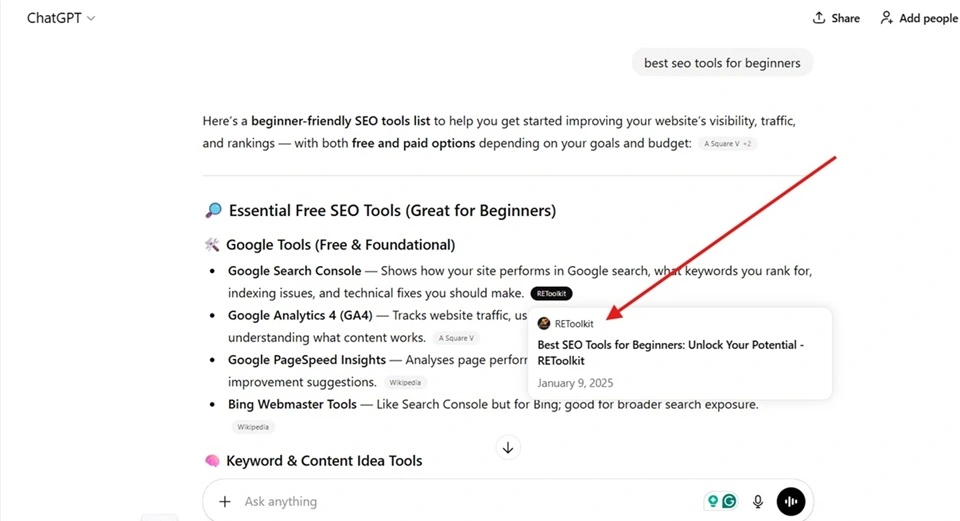
If people find your blog post in ChatGPT and visit your website. They might consider buying from you.
Microsoft Clarity study says, LLM traffic converts 3x more than other channels.
If you’re struggling to grow your blog, you can contact me. I’ll help you.
Noticed what I just did?
#4 Not Publishing Regularly
“Consistency” is a misused word.
People assume that it means daily. Consistency doesn’t mean daily in any dictionary.
Define what consistency posting means for you.
For example. You can write 1 post weekly for 1 year.
You can write 3 posts per week.
Or you can write 1 post per month.
It’s perfectly okay as long as you can stick with it.
You need to define what works for you.
To publish content consistently, create a content calendar and schedule your posts.
#5 Writing Too Long Intros
Don’t reveal the whole post in the introduction section.
Hook the reader with an introduction. In the intro, let them know what they can expect in the post.
When I started my first blog, I used to write longer introductions. Till I realized people don’t read long intros. If you can’t hook and engage them, they’re going to leave your website.
And you can share some proof.
You can see an example from Ahrefs blog.
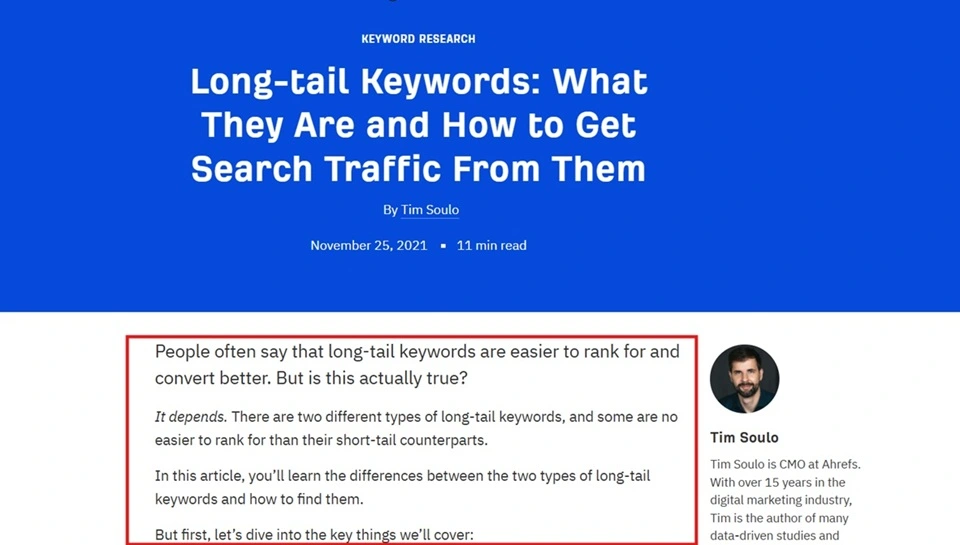
The golden rule to write an intro is to make it short and to the point.
Cut the fluff and get to the point.
#6 Not Optimizing Posts For Search Engines

I can’t imagine bloggers still making the mistake of not optimizing their website and posts for SEO.
You might think people are choosing social media and AI platforms to find solutions.
That couldn’t be far from the truth.
In fact, Google handles approximately 22,083,870,968 searches per day. More than any other out there.
If you want other people to find your website, you need to be found on Google.
To rank your website on the first page, you must prioritize on-page SEO.
Here’s an on-page SEO checklist for you:
- The title should be click-worthy.
- Add your target keyword in the title.
- Write a unique meta description that persuades people to click. You can add your keyword or a related keyword.
- Have a strategic interlinking approach. Make sure you add relevant links. And it should be valuable to your audience.
- Sprinkle your keywords throughout the post. Don’t force your keywords.
- Add external links to make your post more valuable.
- Focus on search intent. This means you need to give users what they are looking for.
- Add ALT text in your images.
- Optimize your URLs. Add the keyword in the title.
#7 Not Building Links
Want to rank higher on Google?
If you said YES, then you need to build links to your website.
Link building is the practice of building links from other websites to your web pages.
Google counts links as votes. If you have more votes, you’ll rank higher on Google.
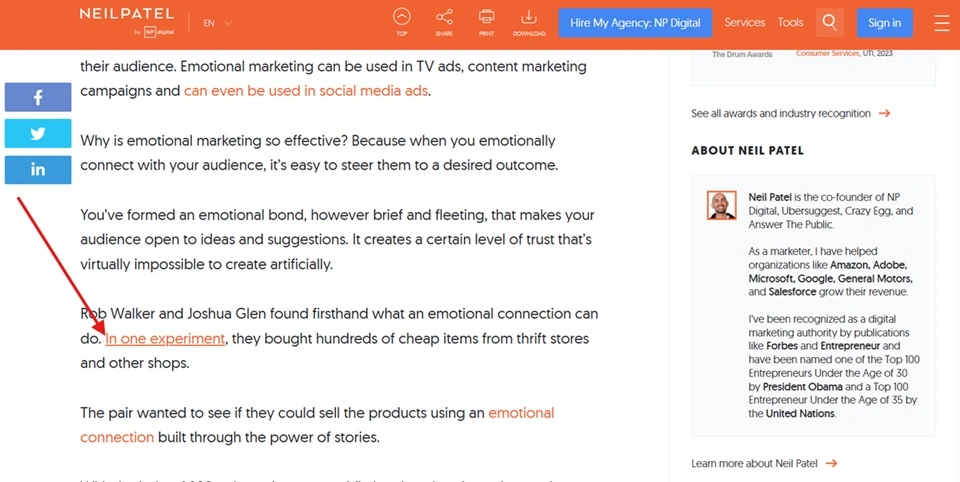
Below, you can see an example in the blog post: Expert’s Guide To Powerful Emotional Marketing. Neil Patel linked to an experiment.
How can you build links?
There are many ways to build links to your website:
- Guest Blogging
- Blog Outreach
- Digital PR
- Broken Link Building
- Brand Mentions
- HARO
- Steal Links From Your Competitor
Link building is a broad topic. Here’s a detailed guide on link building.
#8 Copying Others’ Content
Copying others’ content doesn’t work.
Because people prefer unique content. Because there is already more content than we need. We don’t need more content. We need more unique content.
Plus, Google loves unique content too.
Search engines actively penalize websites with duplicate content, pushing them down in search results.
Beyond SEO, plagiarism can severely damage your reputation and erode the trust of your audience.
You can take inspiration from other bloggers. But you need to create content for your blog. Or you need to hire a subject matter expert.
You should conduct thorough research, share your personal experiences, and develop your own voice.
Remember, building a successful blog takes time and effort, but the rewards of creating original, valuable content are well worth it.
#9 Not Using Data In Your Content

If you have a point, you need to use data to prove it. Because people are too cautious to trust someone. But when you use data, they have no option but to trust.
Data never lies.
When you keep sharing data-driven content, users are going to see you as an authority and a credible source.
People will start remembering your blog name. You’ll get brand searches, which is great for SEO.
Here’s how you can find data:
To find data and stats, simply Google [Your Topic + Statistics]. And it will show you data that you can use.
Here’s an example.
Statista is one of the most popular sites to find stats and data.
#10 Focusing On Quantity

Those days are over when you could publish a ton of low-quality content and expect results. It used to work in the Stone Age.
People are using AI tools ChatGPT, Gemini, and Claude to create content.
According to Semrush, A significant 67% of small business owners and marketers have integrated AI into their content marketing or SEO.
Most of them are using AI to create content. So it’s hard to stand out from the crowd.
You can’t compete with them on quantity. And you shouldn’t.
Solution?
You guessed it right, it’s quality. Focus your effort on giving the best quality content.
Your content needs to be unique and thorough. You can share your experience.
Rather than producing three low-quality posts, focus on creating one highly detailed and data-driven post.
In this post, I’ve done exactly that. I’ve used data, statistics, and my personal experience.
You should analyze the top Google results before writing. If you cannot offer something better, do not publish that content.
When you think like that, I promise your content quality will improve.
#11 Not Promoting Your Content

Creating content is just 20% of the work. The rest 80% is promotion. You might have read it already.
Amateur bloggers throw content on the web and expect people to find it. This kind of magic doesn’t work in real life.
Nobody knows you exist, so how can people read your content?
You need to let people know about your content.
You need a solid blog promotion strategy.
You can use:
- Social Media
- Blog Outreach
- Forums
- Quora
Blog promotion is a huge topic in itself. If I cover all the strategies and actions, it would be a humongous post. Brian Dean shared a super detailed guide on blog promotion. Give it a read.
#12 Not Building Your Email List

Most of your readers leave your website without taking any action.
And you can’t do anything about it, right?
Wrong. You can.
You can capture their name and email address to contact them later. It allows you to promote your blog posts, sell products, and services.
But why would someone give their email address and name?
Good question.
You need to offer something SUPER valuable and lucrative. It’s called a lead magnet.
Some lead magnet ideas.
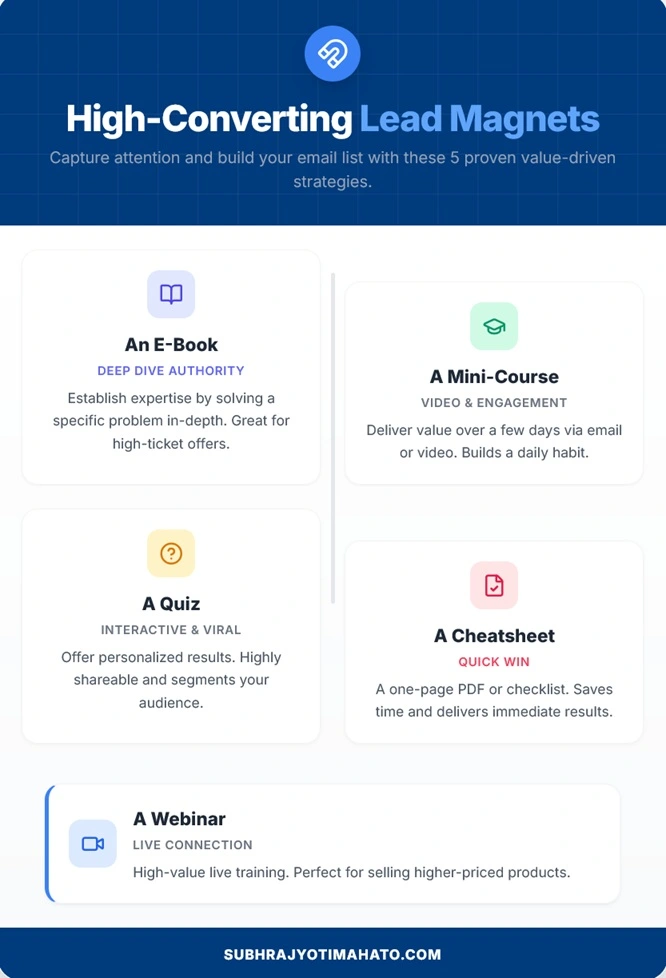
Give people something lucrative, and they’ll give you their email. If your competitors are charging for something, you can offer that FREE to your audience.
If you are looking for beginner-friendly email marketing software, use Kit.
#13 Not Using Visuals

Our brains are wired to process images faster than text, making visuals a powerful tool for capturing attention and conveying information effectively.
You can simplify complex ideas using visuals. It makes them easier to digest and remember.
According to Jeff Bullas, articles containing images get 94% more views.
Plus, when you use infographics, you can attract more backlinks to your blog naturally. Backlinks are hyperlinks on other websites that link to your website.
You can incorporate these types of visuals:
- Screenshots
- Infographics
- Charts and Graphs
- Tutorial Videos
- Behind-the-ScenesVideos
- Animated Videos
Creating visuals is not your cup of tea.
No worries?
You can always hire freelancers to do it. And if you don’t have the budget, you can use Canva or any AI tools.
#14 Checking Your Analytics Multiple Times

I bet you check your analytics multiple times a day.
And you’re not alone.
I used to check my analytics multiple times as well.
Here’s the problem.
It’s easy to get discouraged when you repeatedly check your analytics and see your content isn’t performing well.
And it can affect you and your content quality.
Checking your analytics multiple times will not increase your traffic.
If you are not getting traffic, it’s okay.
It can be fixed.
Blogging is a long-term game.
That doesn’t mean you will not check your Analytics.
You can check it weekly or monthly.
Measuring data is super important. It will help you know what works and what does not.
#15 Focusing On Word Count
You’re not there to impress your school teacher. You don’t need more words.
It’s a common misconception that having more words can help you rank better. But the truth is that simply adding words doesn’t guarantee quality or improved search performance.
Remember, more words don’t equal better quality.
Write long-form content when it makes sense.
When you write a long-form post, you can:
- Make it in-depth
- Provide more data
- Add more topics
It makes both users and search engines understand the content better.
Don’t add fluff for the sake of ranking.
For example, if you are writing a post on Noodle Recipe.
Do you think people are gonna read a 2000-word post?
Nopes.
They would prefer text with some relevant images.
Or they would prefer to watch a video.
When you start writing new content, understand the search intent. And try to satisfy the search intent.
It will help you understand if you should make your content longer or shorter.
#16 Over-Optimizing Posts
Some people get crazy about getting on the #1 page of Google. And they overoptimize their content.
They do keyword stuffing.
They just start adding keywords even if they don’t make sense.
Google’s algorithms are smart and will penalize over-optimized content, preventing it from ranking.
Don’t add keywords where they don’t fit.
#17 Solely Relying On AI Tools To Write
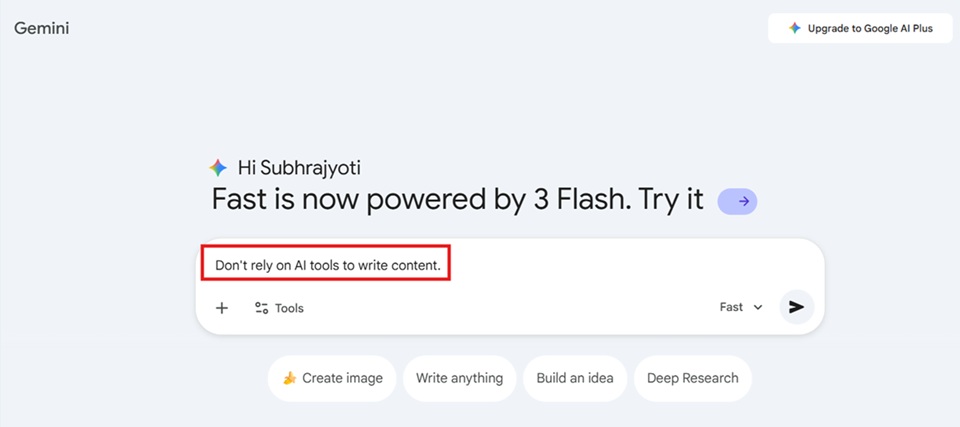
After the launch of ChatGPT, many content marketers and bloggers are using AI tools to create content.
Now there are many AI writing tools out there. People are using them like crazy.
Mass-producing AI-generated content is a recipe for poor results. AI tools come up with what’s already there on the web. Your readers can smell that from a mile away.
AI tools can be helpful for brainstorming, creating content briefs, or drafting. But relying on them for mass content production is not a good idea.
To create high-quality, impactful content, use AI as a supplement to human creativity. You must add your expertise, data, visuals, and unique angle.
My Thoughts
These are some blogging mistakes that people make. By keeping these common blogging mistakes in mind, you can save yourself time and money. And you’ll get your desired results sooner.
Are you making any of these mistakes? Let me know in the comments. I’ll be super happy to help.
