Vibe coding is the practise of generating code using LLMs from natural language prompts. In simple words, anyone having access to LLM can code and build applications using artificial intelligence.
Vibe Coding is a term coined by Andrej Karpathy in March 2025. He described: “There’s a new kind of coding I call “vibe coding”, where you fully give in to the vibes, embrace exponentials, and forget that the code even exists. It’s possible because the LLMs (e.g. Cursor Composer w Sonnet) are getting too good.”
But is it actually working in the real world? From adoption rates to security risks, I’m going to share vibe coding statistics you need to know.
Key Vibe Coding Stats 2026
Let’s see the key statistics of Vibe coding.
- 37% of developers are using vibe coding tools.
- A whopping 92% of U.S. developers use AI coding tools every day.
- Vibe Coding tools are hitting 100 million in record time.
- 25% of Y Combinator startups rely heavily on AI-generated code for their core systems.
- Almost 80% of new developers on GitHub use GitHub Copilot within their first week.
- 63% of non-developers are vibe coding for building their products.
- The US market for AI coding tools is set to grow from $1.5 billion today to $9 billion by 2032.
- Visa, Reddit, and DoorDash now list “vibe coding experience” and AI code generator proficiency (Cursor, Bolt) as job requirements.
Sources: Stack Overflow, v0, GitHub Octoverse, Yahoo Finance, Business Insider
Big Tech Companies Are Vibe Coding
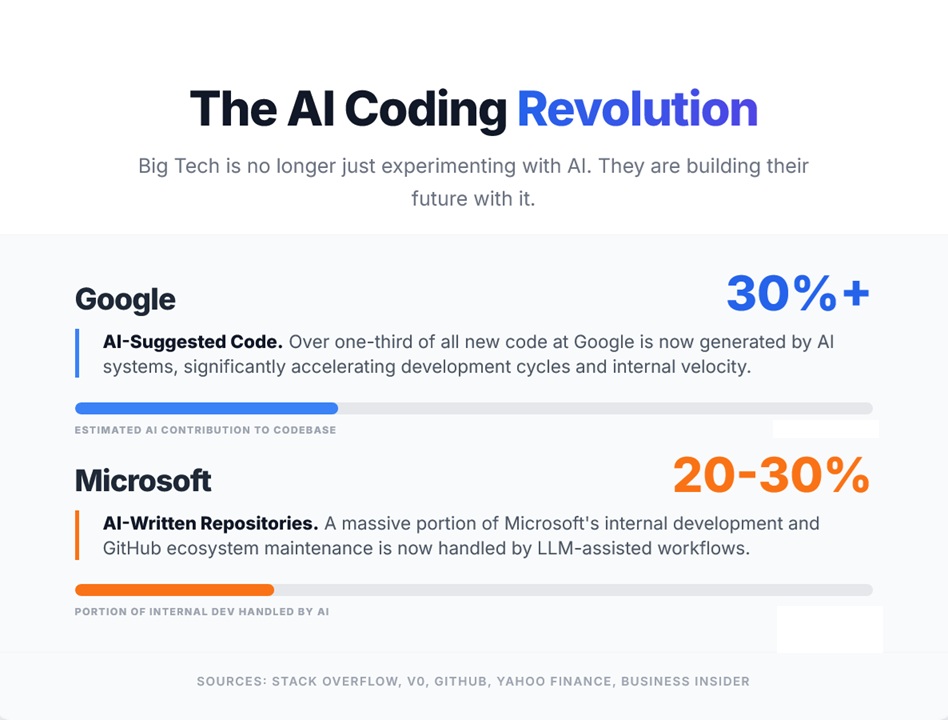
Many people are wondering whether tech giants are using AI-generated code. Let’s see the data.
- As of April 2025, Sundar Pichai confirmed that over 30% of their code was AI-suggested. [Alphabet]
- As of May 2025, Satya Nadella states that approximately 20% to 30% of the code in some of Microsoft’s internal repositories is currently written by AI. [Llamacon 2025]
Vibe Code Platforms
How many vibe code platforms are there? In this section, I’ve included some popular vibe coding tools out there.
- Replit
- Loveable
- Claude Code
- Google Antigravity
- Open AI Codex
- Curser
- v0 By Vercel
- GitHub Copilot
- Bolt
- Emergent
- Windsurf
Vide Code Adoption and Usage (2026)
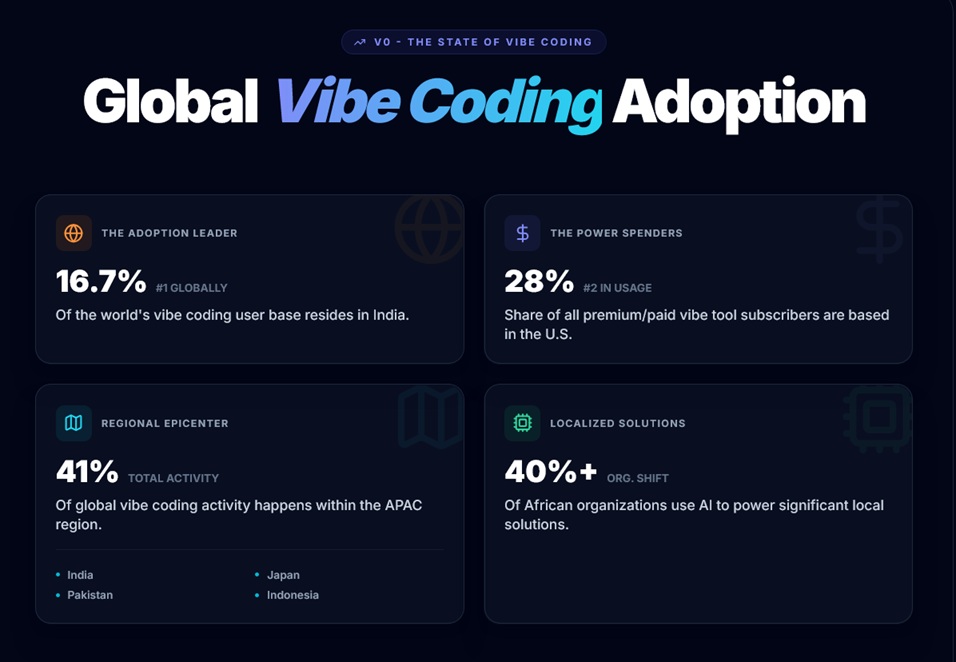
Multiple countries are adopting vibe coding. Let’s take a look at the country-wise vibe coding adoption.
- The U.S. ranks 2nd in overall usage. Their users are paying premium prices for AI tools. In fact, 28% of the paid vibe code tools users are from the U.S.
- India holds the top spot for vibe coding adoption, representing 16.7% of the global user base.
- Nearly half of all vibe coding (41%) happens in APAC, led by India, Japan, Pakistan, and Indonesia.
- More than 40% of organizations across Africa now use AI to power significant local solutions.
Sources: v0
Vibe Coding Trust Gap: Security, Hallucinations, and Skepticism

- More than 46% of developers actively distrust the accuracy of AI tools.
- A recent survey found 96% of IT professionals don’t trust AI-generated code fully.
- In a sample of 2.2 million code samples, 440,000+ referenced hallucinated packages.
- A 2026 security audit revealed that 45% of AI-generated code contains high-risk security flaws.
- AI-generated Java code has a staggering 72% security failure rate.
- Python is the most reliable for AI, with a lower (but still concerning) 38% failure rate.
Sources: Stack Overflow, CIO, UTSA, VERACODE
Vibe Coding Use Cases
Let’s see what people are building with vibe coding.
- Nearly 44% all vibe-coded projects focus on the “Front-end.” It includes building forms, designing layouts, and building interactive components.
- 20% of vibe-coded projects are now full-scale applications, such as e-commerce sites.
- 11% of users use vibe coding to launch portfolios and personal brands.
Sources: v0
Vibe Coding Paradox
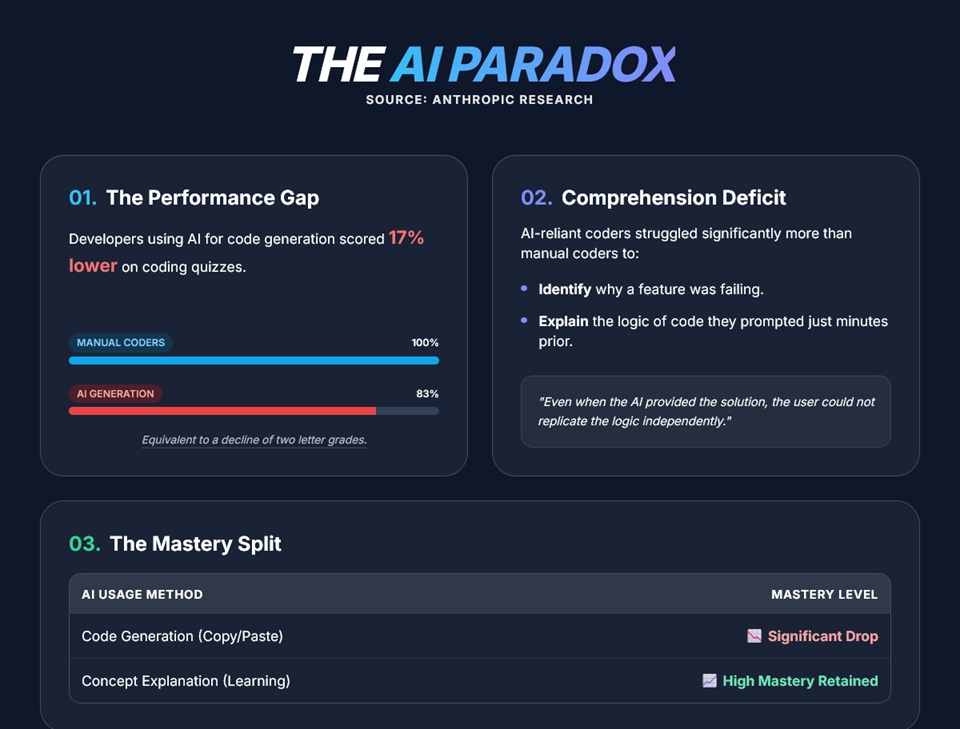
Researchers found that developers using AI assistance finished tasks faster but retained far less knowledge.
- Developers using AI scored 17% lower (equivalent to two letter grades) on coding quizzes compared to those who coded by hand.
- AI users struggled significantly more than manual coders to identify why a feature was failing, even when the AI provided the solution just minutes prior.
- AI users struggled to explain why code failed, even if they were the ones who prompted the AI to write it just minutes earlier.
- Developers who used AI to explain concepts (rather than just generate code) maintained high mastery levels.
Sources: Anthropic
