
You searched “AEO vs SEO.” You read a few articles. And you’re still not sure what AEO actually is or if you even need it.
That’s not your fault. Most content out there is vague, overhyped, and confusing.
SEO took years to figure out. AEO is still being figured out. That’s the truth nobody wants to say.
In this guide, I’ll break down the difference between AEO and SEO.
Let’s dive right in…
What Is AEO?
AEO stands for Answer Engine Optimization. AEO is the practise of structuring your content to increase visibility across AI systems like Google AI Overview, ChatGPT, Claude, Gemini, and Perplexity.
It includes creating and publishing content, making sure AI can find (crawl) your content, and getting third-party validation (brand mention).
Traditional SEO still drives most of the websites. Google processes 189,815 searches per second. That’s a mind-boggling number. No doubt.
But. But. But.
AI is no longer sci-fi. In fact, a study by the University of Melbourne in collaboration with KPMG found 66% of people use AI on a regular basis.
ChatGPT is getting 5.73 billion visits per month. Claude is getting 613.7 million visits. Gemini is getting 2.59 billion visits per month.
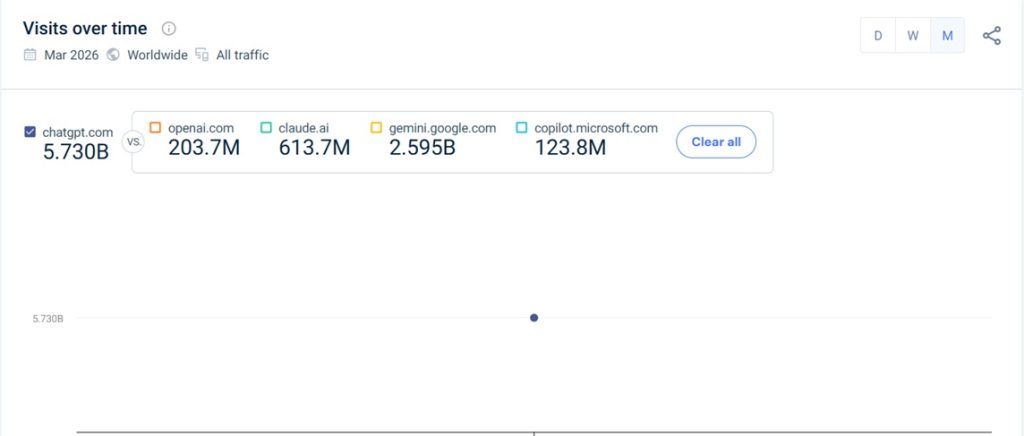
Source: Similarweb
You can’t ignore these numbers.
Your audience is using this AI system to get answers. And you need to try your best to show up on these AI systems.
How Answer Engine Optimization Works?
To understand the differences between AEO and SEO, you need to understand how AEO works.
SEO is optimizing for search engines like Google, Bing, DuckDuckGo, etc. These search engines work similarly.
So if your website is ranking on Google, chances are it’s ranking on Bing and other search engines as well.
But when it comes to AEO, it’s not that simple.
Because each AI system shows you answers differently. ChatGPT might show your content as an answer for a prompt.
When you use the same prompt on Gemini or Claude, you might get different content.
And unfortunately, there’s no way to make sure that every AI system cites and mentions your brand.
Below, I’ll break down how these AI systems work and answer you when you enter a query.
Knowing this might help you to create a better answer engine optimization content strategy for your brand.
ChatGPT
- Pre-trained data
- Optional Browsing (When browsing is ON, it fetches live web pages and cites sources)
Google AI Overview
- AI Overview fetches live search results and then summarizes them using AI at the top of the page
- It always uses current, indexed web data — not pre-trained knowledge alone
Gemini
- Pre-trained data
- Deep Google integration
- Trained on Google’s massive datasets, including web, books, code, etc.
- One of its biggest strengths is leveraging Google’s live search index
Claude
- Pre-trained data
- Trained on a large dataset with a knowledge cutoff of August 2025
- By default, answers come from pre-trained knowledge
- Claude AI web search tool that I use automatically when current/recent information is needed
Perplexity
- Every single answer is backed by live web searches performed
- It uses models like GPT-4, Claude, Sonar (its own model) under the hood
- Always cites sources with numbered references for every claim
- Unlike ChatGPT/Claude, it almost never relies solely on pre-trained data
Grok
- Pre-trained data
- Trained on publicly available internet data
- Has unique real-time access to X (Twitter) posts and trends. This is its biggest differentiator
- Grok uses web search whenever your query needs it
- Can answer questions about what’s trending on X right now
What Is SEO?
SEO is the practice of optimizing a website to increase visibility on organic search results. It includes on-page SEO, technical SEO, and off-page SEO.
SEO is not new. It’s been there for a long time. SEO is simple: write content, optimize your website, and build links.
I don’t mean that SEO is easy. I said, It’s simple.
The goal of SEO is to rank on the first page of Google to get maximum traffic.
But the AEO is not that simple.
Because we don’t know how these AI systems recommend content.
Read Also: Latest SEO Statistics
How Does SEO Work?
SEO has been around for a long time. Now we have more studies and data on how SEO works. And we know Google’s ranking factors.
When someone does SEO, their target search engine is Google. Because Google has a 89.51% market share in the search engine market as of March 2026.
Not all the search engines work the same way. Each search engine has its own architecture, ranking philosophy, and data sources.
But it’s not as complex as generative AI systems.
Here’s a simple formula that all major search engines follow:
- Crawling: Search engine crawlers (bots) crawl the web and analyze pages
- Indexing: Analyzed pages are stored and organized in a massive database
- Ranking: When you search, an algorithm scores and orders relevant results
- Serving: Results are displayed on a Search Engine Results Page (SERP)
Differences Between AEO and SEO
AEO helps your brand get recommended. SEO helps your brand get found.
That’s the main difference between AEO and SEO.
AEO determines whether an AI system trusts your content enough to quote it directly. SEO ensures your content is indexable, crawable, and competitive.
AEO optimizes for AI-generated answers. It can help your brand get recommended or cited by AI systems. Most of the time, users will not visit your website at all.
SEO optimizes for ranking higher on the SERP. So users click on the results and visit your website.
Let’s see how AEO differs from traditional SEO.
Goal
The goal of AEO is to show up in AI-generated responses. By optimizing your content for models like ChatGPT or Gemini, you ensure your brand is the primary source the AI cites when answering a user’s query.
When you optimize a website for SEO, your goal is to rank #1 on search engines like Google. So you create content and follow SEO best practices.
Success Metric
Tracking AEO success metrics is not that simple. Or at least not as simple as SEO metrics.
The success metrics are citations, brand mentions, and visibility. You can use tools such as Semrush, Profound, and Ahrefs to track these metrics.
Most SEO’s track these metrics: keyword rankings, organic rankings, CTR, and conversion rates.
You can track these metrics using Google Search Console, Google Analytics 4, Ahrefs, and Semrush.
Content Format
In AEO, structured content and schema matter more. You need to use a schema to let these AI systems know the type of content.
While AI systems are getting smarter and better at reading plain text, they still rely on Schema to verify that their “guess” about your content is correct ot not. You might have noticed that sometimes these systems provide completely out-of-context answers.
Schema matters for SEO as well. But SEO focuses more on Google keywords and context. Search engine crawlers analyze your web page to understand whether the user wants to buy something, learn something, or find a specific website.
You need to understand the intent of a query before creating content.
User Behavior
Most users type a prompt to get an answer using these AI systems. Then they might refine the answer using another prompt. And they might refine again.
Most users consume your information directly within the AI system’s interface.
Some users might check out the cited sources and visit them. I’m one of them.
On the other hand, when a user types a keyword on Google or other search engines, they look for options.
- If the headline is satisfying, why are they looking for
- If they can trust the website they’re choosing
Users will often hop from one website to the next until they finally find exactly what they’re looking for.
FAQs
Yes. AEO is different than SEO.
If you’ve rock solid SEO foundation, you’re already ahead of most of your competitors. You can’t have an AEO strategy without having an SEO strategy.
No. AEO is not replacing SEO.
But that doesn’t mean you won’t focus on AEO. Because we’ve already discussed the potential of AEO. These AI systems are growing like crazy. A large number of users are using these AI systems.
Chances are, users are asking questions on ChatGPT, Gemini, Claude, and other AI systems. And you don’t want to miss those users.
Not necessarily. In most cases, you need to optimize your existing content. Start by adding direct-answer paragraphs, FAQ schema markup, and a cleaner conversational structure to your existing top-performing pages.
Not quite. SEO optimizes your content to rank on traditional search engines like Google, so users click through to your site. AEO optimizes your content to be cited by AI-powered platforms like ChatGPT, Claude, Gemini, and Google AI Overviews. You need both working together, not one instead of the other.
Conclusion
Answer Engine Optimization is new. Still, SEOs and marketers are experimenting with it. Nobody knows how you can optimize for AEO. Because no AI system has yet published a single guide to increase visibility, get recommended, or get cited.
As of now, AEO is standing on a single pillar of guesswork. If someone says that they can guarantee your visibility across these AI systems, run away from them.
While browsing, I saw many blog posts about AEO vs SEO, which is pretty confusing for a SEO professional as well.
So I created a simple guide to help marketers with AEO vs SEO. I hope you now have a better understanding of AEO.
